
Nimiq is built around a simple conviction: money should be open, self-custodial, frictionless, and easy to build with. The Nimiq community is central to that. Not just as users, but as builders who help shape what the ecosystem becomes.
Today, we are launching the Mini App Framework. It's an interoperability layer that exposes Nimiq's Pay functionality to web apps, enabling them to run seamlessly within the Nimiq Pay app. Developers can now build their own mini apps.
What are Mini Apps?
Mini apps are applications that run directly inside Nimiq Pay, supporting a wide range of in-app experiences, from simple web tools to apps that interact with Nimiq and Ethereum wallets.
What does it look like? Think of it like a specialized browser embedded within the app. Your mini app loads inside Nimiq Pay and, when needed, can request wallet operations like listing accounts, signing messages, or sending payments — all without the user ever leaving. The wallet handles cryptographic operations securely, and every sensitive action goes through a native confirmation dialog.
What Is the Mini Apps Framework?
The simplest mental model is this: Nimiq Pay is the container that provides native functionalities, and the mini app is the embedded front end. It's like Nimiq Pay is the frame you use to paint your painting and show it to the world! The interface the user interacts with is still a standard web app, but when it needs to perform blockchain actions, it does not need to connect to a browser wallet extension. Instead, it talks to the wallet environment provided by Nimiq Pay within your mobile device. That is the key difference from a regular website or a dApp opened in your browser.
A practical way to frame the architecture is:
- The mini app UI loads in Nimiq Pay.
- Nimiq Pay injects the providers.
- The mini app calls provider methods.
- Nimiq Pay shows confirmation dialogs when required.
- After approval, the Nimiq Pay app either executes the action or proxies it and returns the result.
Build with us!
We're looking for testers and builders who want to get their hands on it. If you want to create new experiences in Nimiq Pay, you can start building mini apps right away. You can mix and match with both Nimiq and Ethereum providers or use just one. From payment mini apps to dual-chain utility apps, the world is your oyster. Check out the documentation to build your own mini app or try out vibe coding, since our documentation is AI-friendly. Build a mini app, whether it's simple or more complex, and share your thoughts here. Your feedback helps us improve.
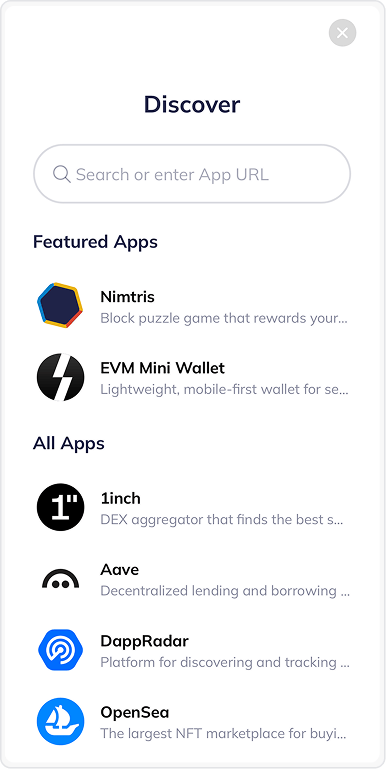
You can also just test the waters. Mini apps are now live in the Nimiq Pay app. Open the Nimiq Pay app, click the Mini Apps library in the bottom-right corner, and see which apps we have.
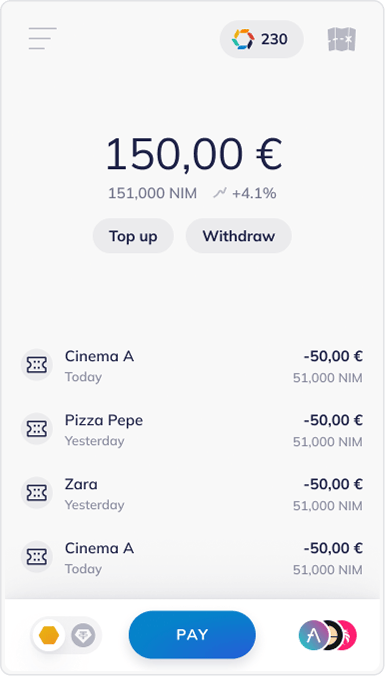
Try it, build something, and tell us what you think on the Nimiq Forum.
Ethereum dApps, Inside Nimiq Pay
One of the long-standing challenges in Web3 is fragmentation. Users jump between chains, apps, and wallets just to get things done. Mini apps are a starting point to change that. Because they can support both Nimiq and Ethereum interactions, different on-chain experiences can coexist in one place, pointing toward a more interoperable future.
Mini apps can also bring existing Ethereum dApps into Nimiq Pay. That means users can access protocols like Uniswap, Aave, or Polymarket from within a payments app built on Nimiq, without the usual friction of switching ecosystems.
You can access:
- Uniswap to swap tokens and trade assets directly from within Nimiq Pay
- Polymarket to participate in prediction markets and put your analysis to work on real-world events
- Aave to lend and borrow assets through one of the most established DeFi protocols around
Developer Center
The Developer Center has been updated alongside this release. It now covers mini apps end-to-end. From getting started to integrating the Nimiq SDK and working with EVM tokens. The documentation is structured to work well with AI coding agents. Developers can install Nimiq-specific skills for tools like Claude Code or Codex to get accurate suggestions without having to prompt their way around incorrect patterns.
The Developer Center will continue to grow as the mini apps ecosystem does.
What's Next?
What we are launching now is a new way to think about what Nimiq Pay can be: not just a place to use your assets, but a place to access a growing set of useful on-chain experiences with less friction.
This is just the tip of the iceberg. We're working to iterate on the framework, add more API endpoints, and build a library full of mini apps for you to try. The ecosystem will expand, and the range of mini apps can become much broader as more people build and experiment.
There's more coming for the mini apps ecosystem. We're planning a mini app building competition, so this is your signal to start testing the Mini App Framework and get a head start. Stay tuned.
Pura Vida, Team Nimiq